14 vehicles, zero utility upgrades, over 75% fuel savings: The EV playbook independent operators actually need
An independent last-mile delivery contractor's full-fleet electrification order proves the single-provider model works and signals a shift in how fleet operators think about going electric.
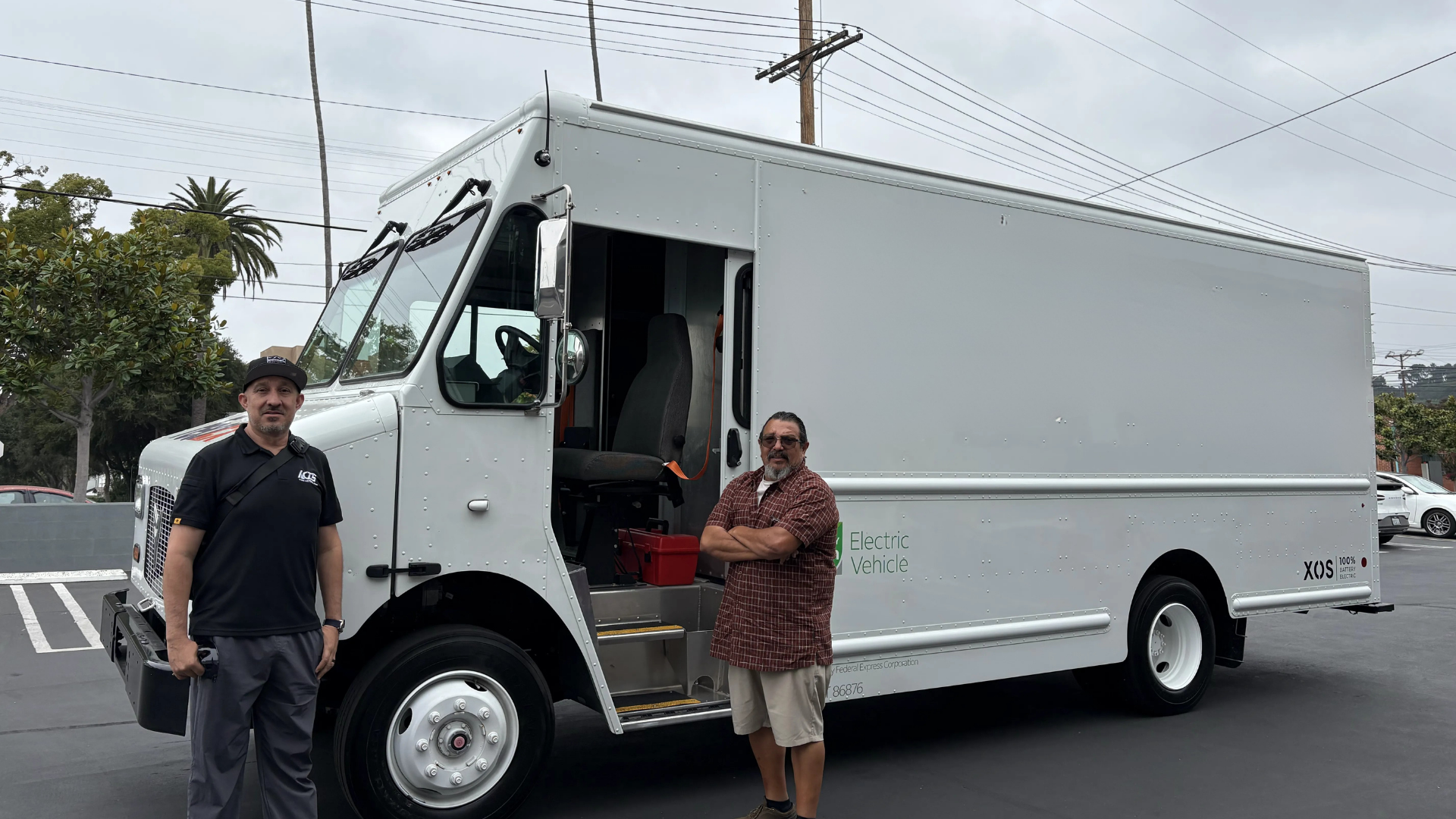
Fluvio Marin, owner of Package Delivery Express, receiving his first Xos Stepvan. 14 vehicles, zero utility upgrades, over 75% fuel savings.
Electrifying a commercial fleet is rarely a single decision, for independent last-mile operators, it involves evaluating vehicles, energy costs, charging infrastructure, depot logistics, and vendor support, often without a dedicated team to manage any of it. The operators who move forward are the ones who find a way to bring all of that under one roof, and the decisions they make tend to look less like a technology adoption and more like a straightforward business call.
Package Delivery Express, an independent parcel-delivery contractor operated by Fluvio Marin, made that call and placed an order for 14 Xos 2026 SV electric stepvans alongside the Xos Hub charging infrastructure, bringing vehicles and energy management under one provider as part of a single commitment.
The savings case, grounded in operating data
The fuel economics of the switch are straightforward, and for an operator running 60-mile daily routes on gasoline stepvans averaging 6 MPG, the 14 Xos 2026 SV electric stepvans ordered to replace them cover that same distance on a single charge, with a range of up to 200 miles depending on configuration. The numbers below show what that difference means per truck and across the fleet.
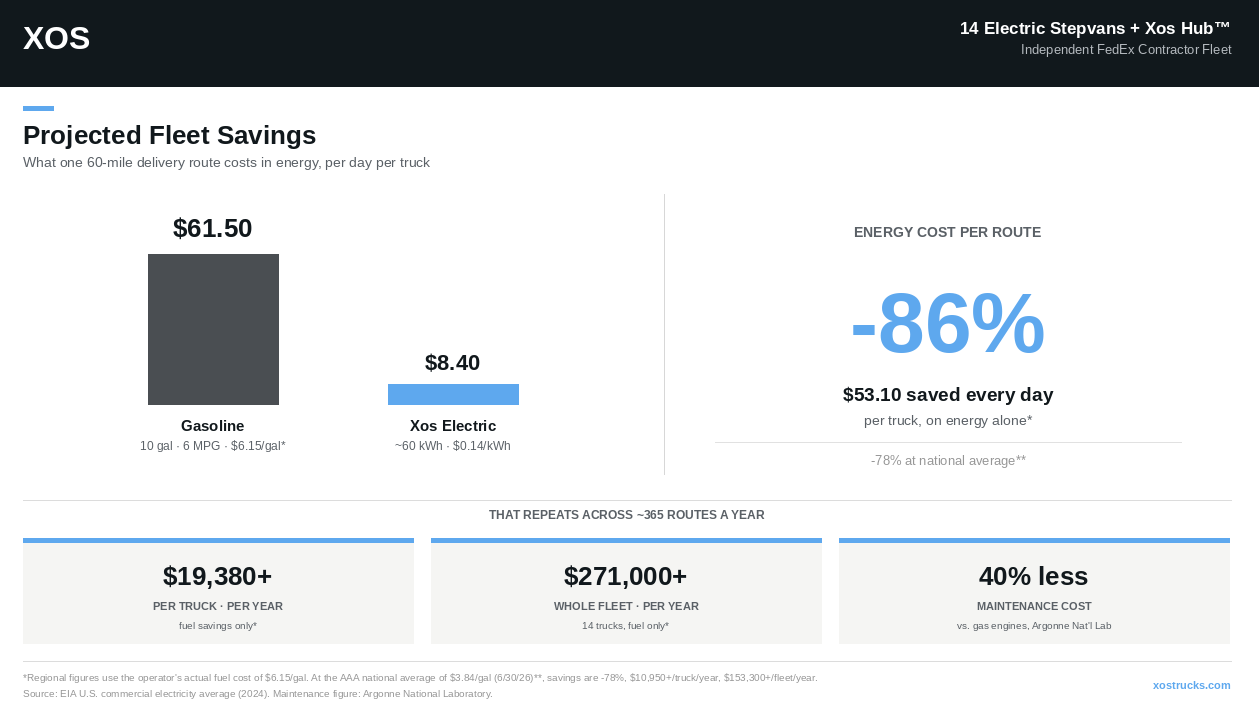
Maintenance costs follow the same trajectory, since electric drivetrains carry significantly fewer moving parts than gasoline engines, reducing scheduled intervals and eliminating several of the failure points that keep conventional vehicles in the shop. According to Argonne National Laboratory, EVs generally cost 40% less to maintain than gas-powered internal combustion engine vehicles, a figure that compounds meaningfully across a working fleet over time.
Vehicles and infrastructure from one provider
Charging infrastructure has consistently ranked as the top operational barrier for fleet operators evaluating electrification, with utility-related challenges cited as the leading concern ahead of vehicle range, cost, or availability, according to a 2024 industry survey by NACFE and Electrada. The complexity of utility coordination, depot permitting, and infrastructure planning adds a layer of project management that sits well outside the core business of running delivery routes, and for many operators that is where the timeline of going electric extends far beyond the vehicle itself.
The Xos Hub addresses that directly. As a mobile energy storage system that deploys at the depot and charges the fleet overnight without utility grid upgrades, it removes the infrastructure coordination step that has historically extended fleet electrification timelines. Package Delivery Express ordered the Hub alongside its stepvans, consolidating vehicles and energy management under one provider and one support structure from the start, which means the transition did not begin with a utility application or a construction schedule.
"Going electric should not require an operator to become an infrastructure expert. The complexity of charging coordination, utility timelines, and depot planning has kept too many fleets on the sidelines. What Package Delivery Express recognized is that Xos solves both sides of the equation: the vehicle and the energy behind it. That is the model we built, and this order is proof it works." said Dakota Semler, Chief Executive Officer of Xos.
Operating under a single-provider model also simplifies what comes after the initial deployment. One point of contact, one support relationship, and a vehicle and charging system designed to work together from day one reduce the integration complexity that typically comes with sourcing hardware from multiple vendors across a working fleet.
"The decision to go electric was driven by the numbers, but what made it operationally viable was not having to manage two separate processes. Vehicles and charging from one provider, with one point of contact, means I can focus on running my routes." said Fluvio Marin, Owner of Package Delivery Express.
What this order means for the segment
An order that covers vehicles and charging together is a different kind of commitment than a pilot program, one that reflects confidence in the economics, the infrastructure, and the operational fit across a real working fleet. For other independent operators in the last-mile delivery segment facing the same transition, the Package Delivery Express case offers something more useful than a product specification: a concrete set of numbers from an operation similar to their own.
The Xos 360° model, vehicles and energy infrastructure from a single provider, is designed precisely for operators who need the transition to work as a business decision rather than an infrastructure project. Package Delivery Express showed that it does.